
Roof racks & EVs: what actually changes when you go electric
Yes, you can load up an electric car or SUV — but range, load limits and choosing an aerodynamic rack matter more than on a petrol car. Here's the honest, evidence-based version, so you buy once and pack with confidence.
TL;DR Your questions, answered in one line
Can I fit a roof rack to an EV?Yes — most EVs and SUVs take bars; you just need a fit matched to your exact model.
Prefer expert help?We've got you — a family business fitting roof racks since 1967. Call and we'll sort it.
What about range and consumption?Small with the right gear — a quality aerodynamic rack is the key; the wrong setup can cost 30%+.
Is it different to a petrol car?Same physics, but you feel it more — EVs are so efficient that drag shows up fast.
How much can the roof carry?Modest — 75–80 kg is common on EVs, and that includes the rack itself.
Bikes, boxes, kayaks, tents?All doable — and a rear/towbar carrier is usually the smarter EV choice.
Best option for range?An aerodynamic rear-mounted cargo box — it barely touches your range.
How do I know it fits?Use our Rack Selector or match make, model & year — checklist below.
Can you even put a roof rack on an EV?
Short answer: almost always yes. An electric car is still a car, and roof bars fit in the same broad ways they always have.
Going electric doesn't lock you out of a roof rack. EVs accept crossbars, roof boxes, bike carriers and more, just like a petrol or diesel car.EV Hub ↗ What changes is how the bars attach and how much you can safely carry.
Many EVs use flush-mounted or integrated roof rails rather than old-style gutters or T-slots, so they need a fit kit made for that exact model. Plenty have flush rails with no visible anchor points, and the maker will list only specific certified crossbar kits as approved. A generic clamp set is the wrong tool; a model-matched foot pack is the right one.
One practical EV quirk worth flagging early: many electric cars sit low and are tuned for slippery aerodynamics, so a loaded roof both adds height (watch car-park booms and drive-throughs) and disrupts a body that was carefully shaped to cut drag.Recharged ↗
Why a good aerodynamic rack matters most
On an EV, the most important choice you make is the quality and shape of your rack. Get that right and the impact on your range stays small.
Anything you add to a car has to push through the air, and it's that air resistance — far more than weight — that affects your range. The good news is it's almost entirely in your control: a bulky, boxy rack behaves very differently to a sleek, lightweight, aerodynamic one. Choosing quality gear designed to slip cleanly through the wind is the single best thing you can do for your EV — and it's exactly what Thule engineers for, with some of the most aerodynamic bars and boxes on the market.Thule ↗
Not all setups are equal
The more aerodynamic and rear-mounted your choice, the more range you keep. Indicative figures at highway speed versus a bare EV.
Synthesised from Thule fleet testing, the AVILOO EV study and independent range tests.Thule ↗Fleet News ↗EV Gas ↗ *Aero rear boxes sit in the car's slipstream and add so little drag that testing shows near-neutral consumption.
The worst case — and why aero matters
How much difference does the right gear make? In a controlled study, the least aerodynamic setup — bikes standing upright on the roof — cut range by around a third at highway speed, and a bulky loaded roof box can cost 15–25%.Fleet News ↗EV Gas ↗ That's the worst case — and it's exactly why a low-profile, lightweight, aerodynamic design is so important. The right gear keeps that number small.
The best solutions barely register at all. Thule's most aerodynamic rear-mounted (towbar) cargo boxes are so streamlined that, in their own fleet testing over thousands of kilometres, cars fitted with the box actually travelled slightly further than with a bare roof.Thule ↗ Aerodynamic shape plus rear-mounting is the winning combination — and it's why we point EV owners toward Thule's lightweight, low-drag range.
When you're packed for a big trip, easing off your top highway speed just a little gives you most of that range straight back — no gadgets required.
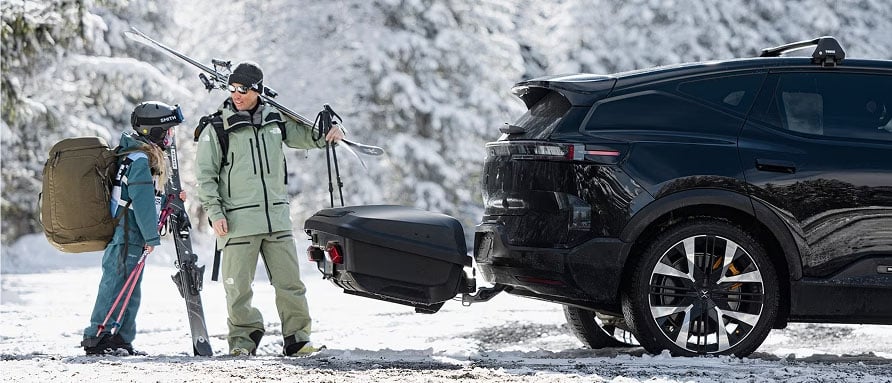 The EV-smart pick
Thule rear-mounted cargo carriers
Towbar-mounted, aerodynamic and easy to load — the most range-friendly way to add luggage space to your EV.
Shop rear carriers →
The EV-smart pick
Thule rear-mounted cargo carriers
Towbar-mounted, aerodynamic and easy to load — the most range-friendly way to add luggage space to your EV.
Shop rear carriers →
Is an EV really different to a "classic" car here?
The aerodynamics are identical. What differs is the consequences — and a few design habits common to EVs.
| Factor | Petrol / diesel | Electric vehicle |
|---|---|---|
| Drag penalty | Same physics | Same physics — but shows up as lost range, not just fuel |
| Why you notice it | Costs a few extra litres | Very efficient, so every kWh counts — and charging stops add time |
| Weight & balance | Lighter, lower centre of gravity | Heavy battery low down, higher effective centre of gravity — roof weight is felt more |
| Aero tuning | Conventional shape | Often optimised for very low drag, so roof gear disrupts a carefully-tuned body |
| Storage alternatives | Boot only | Boot plus a frunk and often a flat floor — sometimes you don't need the roof at all |
So it's not that roof racks "don't work" on EVs — it's that the smart choice leans harder toward aerodynamic, rear-mounted and right-sized solutions than it might on an old wagon.
How much can an EV roof actually carry?
Usually less than you'd guess — and the number you need is almost always lower than the one printed on the rack.
Roof limits on EVs are modest: 75–80 kg is common, and crucially that figure includes the weight of the rack itself, not just your gear.Recharged ↗
Dynamic vs static: the distinction that trips everyone up
There are two limits, and mixing them up is how roofs and racks get overloaded:
| Limit | When it applies | What it covers |
|---|---|---|
| Dynamic | While driving | The moving limit — includes wind, bumps, cornering and braking forces. This is your real ceiling. |
| Static | Parked | What the roof holds when stationary — much higher (often 2–3×). Only relevant to things like a rooftop tent with people inside, at camp.Recharged ↗ |
Your dynamic limit has to cover everything on top: the bars + the box or carrier + the gear inside it. A limit of 75 kg is not "75 kg of luggage" — subtract the hardware first. And always obey the lowest of three numbers: your car's manual, the rack's rating, and the carrier's rating.Recharged ↗
What can you actually fit — bikes, boxes, tents and more
All the usual gear works on an EV. Here's the honest EV-friendliness rating for each.
Roof bars / crossbars
The foundation everything else clamps to. Choose a flat, aerodynamic aluminium bar to keep noise and drag down.
Roof boxes
Loads of weatherproof space for a ski trip or family holiday. On an EV, aerodynamics are everything — Thule's roof boxes are among the most streamlined you can buy.
Roof bike carriers
They work and keep the bike upright — but bikes on the roof are the worst case for EV range and add height.
Towbar bike racks
Sit in the car's slipstream, load at a comfortable height, and cost you far less range than roof-mounted bikes.
Rear / towbar cargo boxes
Hard-shell (aero, weatherproof) or soft-shell (folds away). Thule's are the most range-friendly way to add serious luggage space to an EV.
Rooftop tents
Doable on the right EV, but tents are heavy and tall. This is where static vs dynamic limits really matter.
Ski & snowboard racks
Low, light and reasonably aero. A tidy option for the snow — or tuck skis inside an aerodynamic roof box.
Kayak, SUP & board carriers
Long, light loads that sit low. Fine on an EV within your limits — just expect a highway range dent from the length.
The 5-step EV compatibility check
Run through this once and you'll never buy the wrong rack.
- Identify your exact car.Make, model, year and variant — fixing points differ between builds of the "same" model. Our Rack Selector does this for you.
- Name your roof type.Solid roof, flush rails, or raised rails? This decides which foot kit fits and what the limit is.
- Find your dynamic roof limit.From your owner's manual. Remember it must cover bars + carrier + gear combined.
- Match the load to the job.Bikes → lean towbar. Big luggage → aero rear box or roof box. Snow → low ski rack or ski box.
- Confirm the fit, then check torque.Use a model-specific fitment, tighten to spec, and re-check the fittings after your first drive.
The bottom line
- Yes, you can rack an EV — with a fitment matched to your exact car.
- Aerodynamics is everything — a quality, lightweight, low-drag rack (like Thule's) keeps the range impact small.
- Rear-mounted wins — an aero towbar cargo box barely touches your range, and can even match a bare car.
- Keep the roof light — 75–80 kg is a common EV limit, and it includes the rack.
- Ease off a little when loaded — a slightly lower highway speed gives most of the range back.
- Not sure? The Rack Selector matches the right gear to your car in seconds.
Sources & further reading
- Thule — Packing for an adventure in your electric vehicle (internal EV fleet testing).
- Fleet News & Fleet World — AVILOO EV roof- vs rear-mounted study.
- BGR & EV Gas — EV efficiency and range-loss ranges.
- Automobile Propre (FR) — range impact, weight vs shape.
- Roof-load figures: Polestar 2, Hyundai Ioniq, Kia EV6.
Figures throughout are indicative and rounded to help you plan; real-world results vary with speed, load, weather and vehicle. Your owner's manual is always the definitive source for your car's limits.
Ready to gear up your EV?
Use the Rack Selector to match the right bars, box or bike carrier to your exact car — or talk to a real person. We're an Australian family business and we've been fitting roof racks since 1967.


